On February 28, 2025, a research team consisting of Researcher Gu Yifan and Professor Li Fengting from the Department of Environmental Science at CESE published a commentary article titled "Governance challenges for domestic cross-border carbon capture and storage" in the internationally renowned academic journal Nature Climate Change.
With carbon emissions potentially reaching a new high in 2024, carbon capture and storage (CCS) stands as the only engineering solution currently capable of neutralizing industrial carbon emissions on a large scale, making it a critical technology for countries striving to achieve carbon neutrality. Economies of scale and clustering approaches are vital for realizing the emission reduction potential, commercial viability, and sustainable development of CCS. However, challenges in cross-border governance are emerging as obstacles to the large-scale deployment of CCS due to spatial mismatches between carbon capture sites and storage sites, conflicting cross-border regulations, and local protectionism. The article points out that while international cross-border CCS governance has garnered attention, domestic cross-border CCS governance—which is prevalent yet often overlooked—may face even more complex governance challenges.
The article selects China and the United States as subjects for comparative research, specifically discussing the challenges encountered in domestic cross-border CCS governance and further exploring the significantly different governance challenges arising from heterogeneities in political systems, economic models, and socio-cultural backgrounds. In response, the article proposes a "Synergistic Cluster Governance (SCG)" framework, centered on transparent accountability, equitable compensation, and diversified economic models, to address cross-border challenges.
This article was incubated through an undergraduate social practice project guided by Researcher Gu Yifan. Zhang Xiaoyu, an undergraduate student from the 2021 Top-Notch Basic Discipline Program (Environmental Science) at CESE, served as the first author. The project won the second prize in the 2023 "Zhixing Cup" Shanghai University Students' Social Practice Competition.
CESE has consistently placed great emphasis on social practice. Guided by major national scientific research projects, it highlights the orientation of practical education, leverages professional strengths, and educates and guides students to apply their professional knowledge in practice while integrating insights gained from practice into their academic studies and scientific research innovation. This approach has yielded a series of distinctive educational and research achievements.
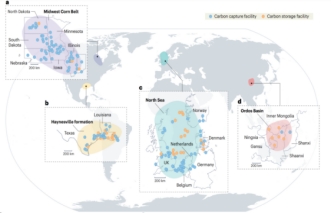

[Global Distribution Map of Commercial CCS Projects] [Photo of Zhang Xiaoyu Conducting Summer Social Practice in 2023]
Article Link: https://doi.org/10.1038/s41558-025-02250-z


 中文
中文 Tel 021-65983869
 Wechat