Recently, a research team led by Professor Jie Ma has made significant progress in the field of capacitive deionization for chloride removal from industrial wastewater. The related findings, titled "Monolithic Low-tortuosity Copper(I) Phosphide Nanorod Arrays for Exceptional Areal Performance in Electrochemical Chloride Ion Removal", have been published in the journal Nano Energy.
Electrochemical deionization technology has become a research hotspot in chloride removal due to its notable advantages including low secondary pollution, low energy consumption, and ease of regeneration. Copper(I) phosphide (Cu3P) demonstrates broad application prospects in electrochemical energy storage and conversion owing to its unique electronic structure, excellent specific capacity, favorable redox reversibility, and low redox potential. Although Cu3P exhibits significant potential for reversible anion storage, its application in electrochemical deionization systems had not been reported previously. Moreover, its reaction kinetics and structural stability still required further enhancement to meet practical application demands.
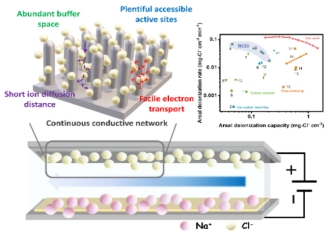
This research proposed a sacrificial template array engineering combined with controlled phosphating strategy to fabricate monolithic low-tortuous Cu3P nanorod arrays (mCu3P NA) with impressive high-areal-performance electrochemical Cl− removal. As expected, the low tortuosity of Cu3P nanoarrays endows rapid ion diffusion and facile one-dimensional electron transport, facilitating accelerated Cl− removal kinetics. Besides, the abundant accessible active sites and sufficient buffer space resulted from low-tortuous structure were conducive to enhancing the deionization capability and improving stability. Consequently, the mCu3P NA electrode exhibited superior areal capacity (2.21 mg-Cl− cm−2) and corresponding the fabulous rate (0.074 mg-Cl− cm−2 min−1) with excellent cycle stability in electrochemical chloride ion removal. This work paves the way for the application of low-tortuous Cu3P arrays for environmental treatment and promotes the development of high-performance Cl− removal electrodes. Professor Jie Ma is the sole corresponding author of the paper. Doctoral student Ziqing Zhou is the first author. The research received funding support from the National Natural Science Foundation of China (NSFC) and the Shanghai Municipal Science and Technology Commission's Domestic Science and Technology Cooperation Program.
Article Link: https://www.sciencedirect.com/science/article/pii/S221128552500151X


 中文
中文 Tel 021-65983869
 Wechat