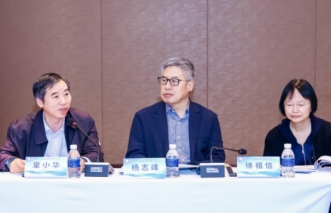
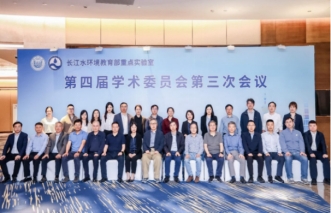
On May 7, 2025, the third meeting of the fourth Academic Committee of the Key Laboratory of Yangtze River Water Environment, Ministry of Education, was successfully held in Shanghai. The meeting brought together distinguished members of the Academic Committee, including Academician Yang Zhifeng, Academician Xu Zuxin, Professor Zhao Jianfu, Professor Guo Jinsong, Professor Huang Yingping, Professor Li Aimin, Professor Shi Jianbo, Researcher Wu Hualin, Professor Xu Xiangyang, Professor Zhu Liandong, Professor Yang Shouye, Professor Yin Daqiang, and Professor Wang Zhiwei. Also in attendance were Tong Xiaohua, Vice President and Academician of Tongji University, and Yang Hua, Deputy Dean of the Science and Technology Research Institute of Tongji University. The gathering saw the participation of over 40 individuals, including college administrators and Party leaders such as Dean Xu Bin, Dean Wang Zhiwei, Vice Dean Zheng Xiong, and Vice Dean Wang Ying from the College of Environmental Science and Engineering, along with the laboratory’s leadership team and key faculty members.
The meeting commenced with an opening ceremony presided over by Yang Hua. Vice President Tong Xiaohua extended a warm welcome on behalf of Tongji University, outlining the university’s recent developments and revisiting the laboratory’s journey under the Ministry of Education. He emphasized the laboratory’s significant contributions to enhancing the water environment quality in the Yangtze River Basin and advancing the comprehensive protection of the river.
Academician Yang Zhifeng chaired the Academic Committee meeting. Professor Wang Zhiwei, Director of the Laboratory, delivered the 2024 annual work report, which highlighted achievements in team building, scientific research, knowledge transfer, talent training, and social service. He also underlined the laboratory's notable scientific outputs and effective management practices while presenting the key objectives for the coming year.
Two young academic researchers, He Huan and Peng Guotao, shared academic presentations titled “Risk Control of Bacterial Resistance in Urban Water Cycle Systems” and “Immunological Effects and Mechanisms of Pollutants Mediated by Gut Microbiota,” respectively, reflecting the laboratory’s focus on emerging challenges in environmental science.
The Academic Committee members recognized the laboratory's progress over the past year and offered constructive feedback concerning the strategic direction, international collaboration, resource mobilization, and talent development. The committee also reviewed and approved the proposed open research projects for laboratory funding, marking a forward-looking step in the lab's evolving research agenda.


 中文
中文 Tel 021-65983869
 Wechat