In May 2025, Prof. Lei Zhendong/Prof. Wu Deli from our college, in collaboration with Prof. Shuai Li from Fujian Agriculture and Forestry University, have achieved a major breakthrough in the development of biodegradable plastic alternatives from agricultural residues. Their research, titled “Recombination of agricultural residues into moldable composites”, was published in the prestigious journal Science Advances. This innovative work provides a new strategy for the high-value utilization of low-cost agricultural and forestry waste.
Modern society relies heavily on plastic products, but traditional petrochemical-based plastics are typically non-degradable and difficult to recycle, leading to the growing threat of microplastic pollution to both the environment and human health. In recent years, the development of biodegradable plastics and composites from renewable lignocellulosic biomass—such as wood and crop straw—has become a frontier research focus.
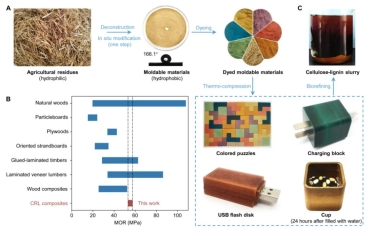
In this study, the team developed a practical “in-situ cell wall recombination” technique. Through a three-step process of disassembly, modification, and recombination, the biomass cell wall components are restructured. The resulting cellulose and hydrophobic lignin powders are then hot-pressed into cellulose-reinforced lignin (CRL) composites. These CRL materials—produced from corn stalks, rice straw, and wheat straw—exhibit excellent mechanical strength, thermal stability, water resistance, wear resistance, and flame retardancy. The process enables agricultural residues to be molded into flat or complex-shaped biodegradable materials, offering a sustainable alternative to traditional plastics.
This research opens new avenues for reducing dependence on fossil-based plastics and advancing the resource-efficient use of agricultural waste. The work was supported by the National Natural Science Foundation of China and the National Key R&D Program of China.
Article link: https://www.science.org/doi/10.1126/sciadv.adv3533


 中文
中文 Tel 021-65983869
 Wechat