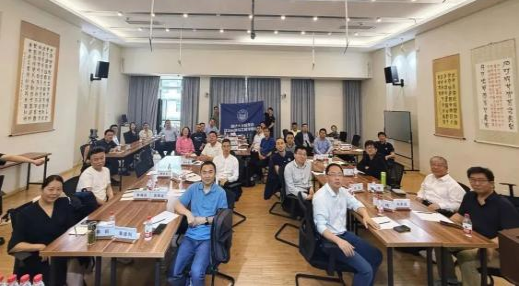
On May 18, 2025, CESE, in collaboration with the GENIES Environmental Platform initiated by Jilian Environmental, held the first edition of the "Tongji Environment π Industry-University-Research Salon." Themed "Challenges of Sewage Treatment in Industrial Parks," the event aimed to foster collaborative innovation and enhance the alignment between academic research and real-world industrial needs in the environmental sector.
The salon brought together top enterprises, research institutions, and policy experts from the environmental governance chain. Among the participants were representatives from Shanghai Chengtou Group, SUEZ NWS, Sino French Water Development Company Limited, Shanghai Environmental Group, Shanghai Municipal Engineering Design Institute (Group) Co., Ltd., Tongji Architectural Design (Group) Co., Ltd., WELLE Group, and Bright Environmental Group. Their joint presence underscored a collective commitment to identifying innovative technologies and practical strategies for the green transformation of industrial sewage treatment systems.
Dr. Lu Qin, the founder of the GENIES platform and Secretary-General of the Tongji University College of Environmental Science and Engineering Alumni Association, opened the event with remarks outlining the series' purpose and significance. He also introduced the guest speakers and enterprise representatives, setting the stage for collaborative discussions.
Professor Ma Luming presented a keynote report on “Key Aspects of Advanced Oxidation Technologies and the Application of Ozonation Catalysts.” By integrating theoretical frameworks with engineering project experiences, his presentation introduced new technical pathways to improve sewage treatment processes in industrial parks.
Shi Wei, Marketing Director at Bright Environmental Group, addressed the specific challenges faced by chemical industrial parks. He shared valuable insights from practical cases in Nanjing and Jiaxing Port, emphasizing the effectiveness of centralized and integrated upstream-downstream wastewater treatment systems.
In the panel discussion, participants exchanged views on the technical and operational challenges in industrial park sewage treatment. Topics included the treatment of complex organic matter, water quality variability, and the integration of pre-treatment, biochemical, and advanced treatment methods. Discussions also touched on issues such as monitoring technology, design-operation coordination, cooperation with upstream enterprises, regulatory compliance, staff pressures, and cost-effectiveness. The dialogue resonated deeply with the audience, reflecting shared concerns and a unified drive toward sustainable industrial development.


 中文
中文 Tel 021-65983869
 Wechat