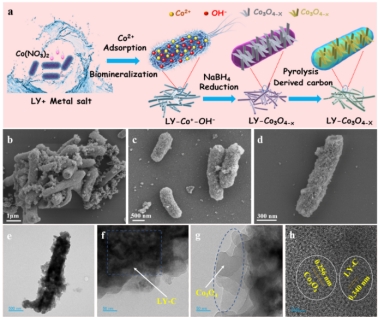
Recently, a research paper titled "Bacillus Cereus-derived Hollow Carbon Rods/Oxygen-Vacancy-Rich Co3O4-x Nanosheets by Biomineralization Strategy for Boosting Lead Ions Capture," authored by the team of Professor Jie Ma from CESE has been published in Advanced Functional Materials. This study innovatively utilized the "biomineralization" function of Bacillus cereus to successfully construct a composite electrode consisting of hollow-derived carbon rods (LY) coated with oxygen-vacancy-rich Co3O4-x nanosheets (LY-Co3O4-x). Under a working voltage of 1.60 V, LY-Co3O4-x demonstrated exceptional Pb2+ removal performance, with an adsorption capacity of up to 78.7 mg g⁻¹ and an adsorption rate of 2.62 mg g-1 min-1, surpassing the vast majority of reported electrode materials. This discovery opens up a new pathway for constructing metal oxides using microorganisms and regulating their electrochemical activity.


 中文
中文 Tel 021-65983869
 Wechat