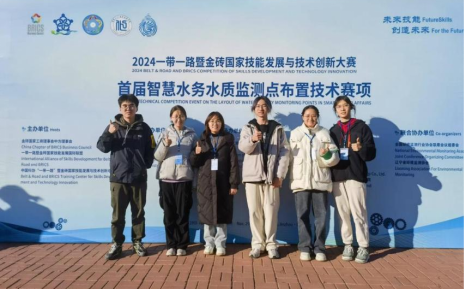
From November 29 to 30, 2024, the Smart Water Quality Monitoring Point Layout Technology Competition, part of the 2024 Belt and Road & BRICS Skills Development and Innovation Competition, was held in Jinzhou, Liaoning Province. Representing the College of Environmental Science and Engineering (CESE) at Tongji University, two student teams achieved remarkable success, each winning a national second prize.
The two CESE teams were composed of six students: Shen Weixin, Zhang Jingyan, Luo Huajiao, Li Siyue, Chen Yuxian, and Zhou Siyu. Under the guidance of Associate Professor Li Shuping, Associate Professor Yan Hexiang, and Associate Researcher Shi Jun, the teams stood out amid intense competition. Their performances showcased excellent teamwork, technical competence, and a deep understanding of smart water management systems. These achievements highlighted the strength of Tongji University’s environmental engineering students in applying their knowledge to real-world, innovative challenges in the field of intelligent water monitoring.
CESE has, in recent years, strongly promoted "competition-driven teaching" and "competition-driven learning," playing a key role in organizing various competitions at the provincial and ministerial levels. Through this approach, the college aims to cultivate high-level professionals equipped with global perspectives and cutting-edge skills relevant to today’s environmental challenges.
The BRICS Skills Development and Technology Innovation Competition was initiated by the Skills Development Working Group (Chinese Side) of the BRICS Business Council in late 2016. Organized by the Belt and Road & BRICS International Skills Development Alliance, the competition seeks to strengthen talent development among BRICS countries, serve the needs of advanced manufacturing, and foster international cooperation in skill-building.
The Smart Water Quality Monitoring Point Layout Technology Competition was divided into two main components: practical application of software for automatic layout and analysis of water supply network monitoring points, and the preparation of analytical reports assessing layout plans. Participants engaged with advanced international technologies, deepening their understanding of smart water systems, simulation analysis of water networks, and effective strategies for water quality monitoring point placement. This hands-on experience prepared students to contribute meaningfully to the smart water industry and underscored CESE’s commitment to producing forward-thinking environmental professionals.


 中文
中文 Tel 021-65983869
 Wechat