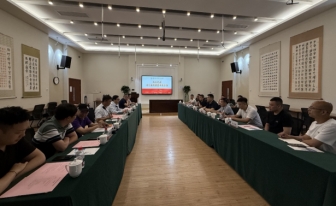
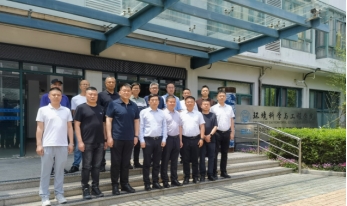
On May 22, 2025, Liu Yan, Deputy Secretary of the County Party Committee and County Mayor of Wuji County, Shijiazhuang City, Hebei Province, led a delegation to the College of Environmental Science and Engineering (CESE) for a symposium aimed at strengthening local-university cooperation. The delegation was welcomed by CESE Dean Wang Zhiwei and Vice Dean Wu Deli, who also chaired the meeting.
Dean Wang extended a warm welcome to the visiting delegation and highlighted the college's commitment to supporting the sustainable development of local communities. He emphasized CESE’s responsibility in applying its technological expertise and academic resources to assist Wuji County in addressing environmental challenges and advancing its green transformation. Mayor Liu Yan provided an overview of Wuji County’s economic and social development, along with its current industrial landscape. He outlined key challenges in the region’s transition toward sustainable practices, including improving wastewater treatment efficiency, promoting resource recycling, and enhancing integrated environmental governance. He expressed strong interest in deepening cooperation with CESE to support high-quality industrial development.
Vice Dean Wu Deli gave a detailed presentation on the college’s academic strengths, research achievements, and ongoing societal engagement. Yu Qin, Vice Dean of the Environmental Branch of the Tongji Design Institute, and Hu Guolin, Chief Engineer, shared practical experiences and case studies from their leather wastewater treatment projects.
The two parties engaged in in-depth discussions on practical topics such as sludge disposal, the optimization of wastewater treatment facilities, circular water use, and collaborative talent training. The talks reflected Wuji County’s urgent need for technical innovation and strategic guidance to achieve its green development goals.
In a joint commitment to long-term collaboration, Mayor Liu Yan and Dean Wang Zhiwei agreed to establish a regular exchange and mutual visit mechanism. The partnership aims to align academic research with on-the-ground environmental needs, promote knowledge transfer, and enable shared progress toward sustainable development.


 中文
中文 Tel 021-65983869
 Wechat