On June 13, 2025, the 8th China (Shanghai) International Invention and Innovation Exhibition & 2025 University Invention Competition was held at the Shanghai World Expo Exhibition and Convention Centre.
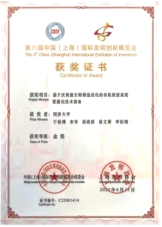
With the support of the Ministry of Education's Industry-University Cooperation and Collaborative Education Project, led by Teacher Hua Yu from CESE, and under the joint guidance of Professor Dai Xiaohu, Teacher Xu Junqing, Teacher Gerile, and Dean Zhang Yue from the Water Industry Division of the China Civil Engineering Society, a student team from CESE presented the project titled "Efficient Organic Solid Waste Resource Utilization Technology and Equipment Based on Anaerobic Microbial Screening and Activation."
The project stood out among numerous entries, earning a Silver Award in the university competition and a Gold Award at the exhibition. This marks yet another significant accomplishment in CESE’s ongoing efforts toward industry-education integration and collaborative talent cultivation.
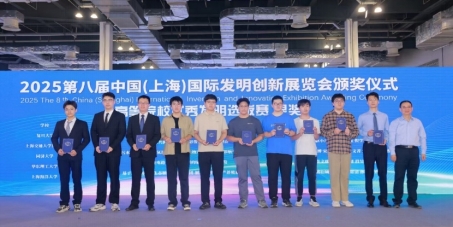
Tan Zhengtong (third from the right), a 2024 postgraduate student, accepted the award on behalf of the project team.
To address the challenges commonly faced by enterprise-scale, 10,000-ton anaerobic digestion projects such as low activity of functional microorganisms and slow reaction rates in multi-medium complex systems the faculty-student team from CESE developed an innovative solution. By integrating macro-scale fluid dynamics, micro-bubble adhesion mechanisms, and interfacial thermodynamic property analysis, the team independently designed and developed a self-sustaining air-flotation anaerobic digestion technology and equipment, based on the screening of active microorganisms and optimized materials.
A demonstration system was successfully established at the project site. Leveraging the self-generated gas produced during anaerobic digestion, the technology enhances the efficient retention of light, undecomposed organic matter, and functional microorganisms, particularly those from the acid-producing bacterial phylum, within the system. Meanwhile, heavy materials enriched with fine sand and humus are utilized in place of traditional fully mixed discharge systems at the lower layer.
As a result, the system achieved remarkable performance improvements:
· Organic matter degradation rate increased by 77%
· Methane content rose to 74%
· Methane production rate improved by 20%
These advancements significantly enhance the efficiency of methane resource conversion. The outstanding results were highly praised by the application unit. Furthermore, the equipment design and operation plan have received 11 patent authorizations across five countries, China, the United States, Germany, Italy, and Australia. The project also previously won the Grand Prize at the 19th National Environment-Friendly Science and Technology Competition.


 中文
中文 Tel 021-65983869
 Wechat